
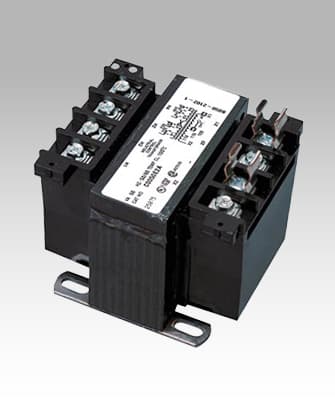
A control transformer transfers energy between circuits while stepping voltage to levels suited to contactors, PLCs, relays, and instrumentation. Sri Tulasi builds single-phase units from 100 VA up to 10 kVA with primary usually on mains-derived input and secondary at 110 V, 200 V, or 230 V as required. Windings on a common magnetic core allow precise voltage transformation while limiting inrush and supporting intermittent control duty. Range coverage on the legacy site includes 1 PH, 2 PH, 3 PH, and 2 PH–1 PH combinations for specialist panel builders.
Key Features
- Step-up / step-down capability via primary/secondary turn ratio
- Delta/star, star/star, auto-wound, step-up/step-down system connections on larger types
- Regulation better than 3.5% on quoted reference designs
- Dielectric strength 2.5 kV for 60 s class wording on datasheets
- Insulation resistance better than 100 MΩ
- Natural or forced-air cooling; open execution typical
Where it is used in real life
Everyday situations—not just industry names—so you can picture whether this product is relevant for you.
Motor starters and machine panels
- A motor starter cabinet needs 110 V or 230 V for contactor coils while the plant runs on 415 V three-phase—control transformers supply that safe, predictable low-power circuit.
- CNC or press machines where the operator station, sensors, light curtains, and safety relays must not float at line voltage—technicians work safer during fault finding.
- Conveyor lines and packaging machines where dozens of small relays and timers all need the same control voltage derived once from the mains incomer.
Elevators, HVAC, and building controls
- Lift controllers and door drives that expect a stable control voltage separate from the traction supply so doors open level even when the hoist motor loads the bus.
- BMS panels, fire-alarm extenders, or actuator banks in commercial buildings where control wiring is long and must stay at a standard voltage regardless of floor loading.
- Chiller plant rooms: valve actuators, pump starters, and field sensors often share a dedicated control transformer so BMS logic does not ride on raw 415 V.
Water, wastewater, and utility-style panels
- Pump stations and STP plants where PLC racks, flow transmitters, and motor starters sit in one outdoor kiosk—control transformers isolate delicate electronics from motor starts.
- Ring-main units or compact substations with auxiliary AC for heaters, lights, and trip circuits stepped from the medium-voltage side via control magnetics.
OEM skids and process skids
- Packaged pump or dosing skids shipped abroad where the panel builder standardises on 230 V control even if site line voltage differs—one drawing set fits many countries.
- Chemical injection or gas train skids where the buyer specifies intrinsically safe barriers fed from a dedicated control transformer for repeatable commissioning.