
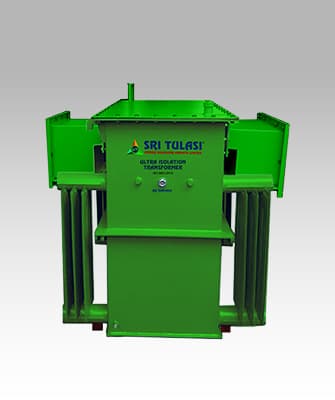
Ultra isolation transformers (UIT) extend creepage, clearance, shielding, and winding discipline to deliver superior common-mode rejection and minimal leakage current. They suit medical imaging, precision manufacturing, and other environments where equipment manufacturers specify enhanced isolation. Catalogue text highlights floor-mounted air- or forced-air-cooled execution, CRGO cores, copper or aluminium windings, high efficiency on kVA bands, and multi-point electrical strength tests between windings and frame.
Key Features
- Configurations Delta/Star, Star/Delta, Star/Star; ratios 1:1 and 2:1
- Regulation better than 3.5%; power factor window 0.75 lead/lag
- Coupling capacitance down to 0.01 pF for 100 dB class wording
- Leakage current < 20 µA on published curves
- Class H insulation with MS enclosure and glanded terminations
- Optional LED/DVM indications and BIS/IEC-aligned construction
Where it is used in real life
Everyday situations—not just industry names—so you can picture whether this product is relevant for you.
Operating theatres and ICU clusters
- Life-support and bedside stacks where leakage current limits are written into procurement specs—every milliamp counts near conductive fluids and pacing leads.
- When multiple devices share a patient environment and the hospital wants an extra isolation stage beyond a normal UPS so a fault on one branch does not propagate.
- Neo-natal and pediatric ICUs where many small monitors and warmers run simultaneously; ultra-isolation backs the electrical ‘safety net’ the clinical team expects.
Medical imaging suites
- CT/MRI support rooms where vendors document power quality and isolation before sign-off—delays in commissioning cost revenue per unused scan slot.
- PET and hybrid imaging suites with chilled plant and RF shielding on one service—extra isolation reduces conducted noise that could disturb low-level detector front-ends.
Metrology and precision electronics factories
- Calibration benches or semiconductor probe stations where micro-amps of noise and common-mode shift directly change measurement uncertainty.
- Aerospace and defence electronics test cells where customer audits require demonstrable isolation from the plant bus.
Pharma, biotech, and cleanrooms
- Lyophilizers, autoclaves, and environmental chambers in Grade B/C rooms where instrument racks must not see neutral bounce from large thermal loads.
- Cell culture labs with incubators and microscopes on one panel—stable, low-leakage feeds reduce unexplained culture losses blamed on ‘electrical noise’.