
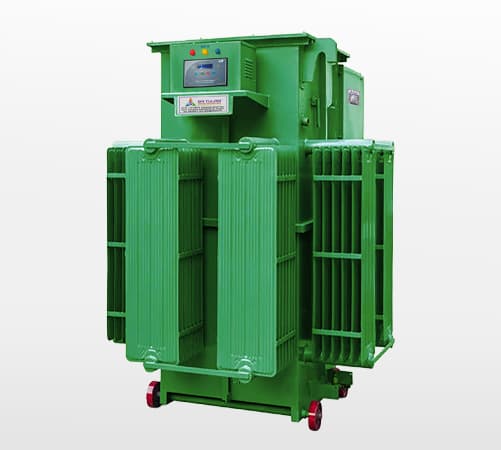
The three-phase linear model voltage stabilizer family is designed for large industrial and commercial plants where output voltage must stay within a tight band despite wide input swings. Oil-cooled versions from 25 kVA to 5000 kVA use efficient heat dissipation for continuous duty. Regulation relies on a linear-type vertical rolling-contact principle with double-wound buck/boost magnetics, electronic control and metering, and robust mechanical design. Typical input/output combinations include 340–480 V (and other common bands) with three-phase 415 V / 400 V ±1% output at 50 Hz. Benefits called out on the legacy site include high energy savings, low losses in boost/buck, suitability for 100% continuous duty, long service life, and depreciation-friendly installed cost profiles for industrial users.
Key Features
- Oil-cooled linear vertical rolling-contact regulator for high ratings
- Double-wound buck/boost transformer with electronic control
- Typical efficiency 98.5–99.5% depending on rating and tap plan
- Designed for 100% continuous duty cycle
- Low waveform distortion and stable output under load swings
- Indoor / outdoor execution with uni-directional wheel mounting options
Where it is used in real life
Everyday situations—not just industry names—so you can picture whether this product is relevant for you.
Large factories and continuous process plants
- Steel, cement, or chemical plants where entire bus sections dip when a big motor, kiln, or compressor starts—risking batch loss, furnace trips, or PLC safety shutdowns.
- Paper, plastic extrusion, or glass lines that must run 24×7 and cannot tolerate wide voltage swings on the shop floor without thickness or quality drifting.
- Automotive paint shops and robotic welding lines where voltage excursions translate directly into rework and scrapped bodies.
Hospitals, campuses, and commercial towers
- Central plant rooms feeding chillers, lifts, and fire pumps where the utility feed is shared and sag-prone at peak summer load or when neighbouring towers start chillers together.
- IT blocks or data halls inside a manufacturing campus that share the same HT/LT interface as heavy machines—stabilization at the plant incomer protects both worlds.
- University campuses with labs, auditoriums, and hostels on one ring: exams, research instruments, and student rooms all benefit from a steadier backbone.
Infrastructure and utilities interfaces
- Sites where the DISCOM feed stays inside statutory limits on paper but your internal quality standard is tighter for CNC, metrology, or export testing lines.
- Outdoor or indoor substation-adjacent installations where oil cooling is preferred for continuous heat rejection and long thermal headroom in tropical summers.
- Ports, logistics hubs, and cold-chain warehouses at the grid edge where feeder length and motor starts create larger swings than city-centre consumers see.
Data centres, broadcast, and high-value process
- Edge data halls or disaster-recovery suites co-located with industrial load—front-end stabilization reduces UPS cycling and battery wear.
- TV studios and live-event venues where lighting and HVAC load swings would otherwise walk voltage through the building during a broadcast.