
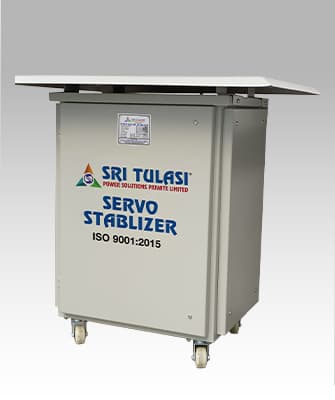
The Sri Tulasi Servo Controlled Voltage Stabilizer (SCVS) is built to tackle a wide range of input voltage variation. The air-cooled range spans approximately 6 kVA–200 kVA and is suited to balanced and unbalanced loads that need tight voltage regulation. Units undergo regular quality checks—including sub-assembly, baking, and accelerated life tests—before dispatch. SCVS is widely applied on CNC machines, printing presses, medical equipment, textile and spinning mills, cold storage, food processing, CT/MRI suites, retail, telecom, restaurants, and office infrastructure. Single-phase models from 1 kVA–20 kVA use advanced servo-motor control to hold the output steady, with compact construction, fast correction, and protections suited to sensitive single-phase loads.
Key Features
- Capacities 1 kVA–20 kVA (1 PH air cooled) with higher three-phase ratings available
- Output regulation typically ±1% of set voltage across specified input and load
- Correction speed around 35 V/s (or as specified)
- Efficiency better than 98% on many ratings
- Natural air / oil cooled options and fully automatic operation
- Standard protections: low/high voltage, overload/short circuit, audible alarm
Where it is used in real life
Everyday situations—not just industry names—so you can picture whether this product is relevant for you.
Homes, shops, and small businesses
- When lights dim or brighten every evening because the neighbourhood voltage swings, a stabilizer keeps your TV, fridge, washing machine, and inverter input steady so motors and electronics last longer.
- Small workshops running a lathe, grinder, welding set, or compressor where the mains flickers when neighbours switch heavy loads on—you avoid spoiled workpieces and nuisance trips.
- Bakeries, tailoring units, and printing shops on a weak rural or urban feeder where a single sag would reset a digital cutting table or embroidery machine mid-job.
Hospitals, clinics, and diagnostic centres
- CT, MRI, and X-ray suites need steady voltage so scans are not ruined by a dip during the scan and patients are not recalled for repeats.
- Operation theatres and ICUs where ventilators, infusion pumps, and patient monitors must not reset when the grid fluctuates during storms or feeder switching.
- Dental chairs, laser treatment rooms, and pathology analysers that show error codes when supply wanders outside the narrow band the OEM specifies.
Factories, cold rooms, and food production
- Cold storage, ice plants, and dairy chill chains where compressors must not stall when input voltage sags in summer or when multiple cold rooms start together.
- Food processing lines—mixers, ovens, conveyors, and packaging fillers—that trip if voltage drops even for a few seconds, wasting batch and cleaning time.
- Beverage bottling and pharma packaging where a momentary undervoltage can fault a PLC and stop an entire shift until engineers reset the line.
Offices, retail, and telecom
- Server rooms and billing computers in malls or banks where a brownout corrupts data, reboots routers, or drops card transactions at the worst moment.
- Mobile tower or BTS shelters in weak-grid areas where radio and power equipment expects a narrow voltage band despite long cable drops and shared diesel backup.
- Co-working spaces and BPO floors with hundreds of desktops and AC—stabilizers at the incomer reduce help-desk calls from random reboots during peak summer load.
Education, hospitality, and public buildings
- Schools and colleges: projectors, language labs, and computer rooms that share a transformer with hostels and kitchens—stabilized incomers keep exams and online classes running.
- Hotels and banquet halls: kitchen cold rooms, lifts, and AV for weddings all load the same service—steady voltage avoids complaints when the grid dips during peak functions.