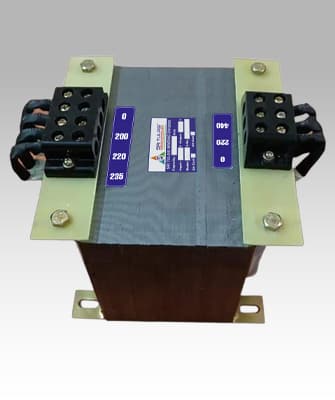
Step-down and isolation transformers sized for lighting circuits, control power, and auxiliary feeds in buildings and factories. Supports stable voltage for LED drivers, discharge lighting, and long cable runs.
Key Features
- Reduces grid voltage to safe utilisation levels
- Protects downstream appliances from sustained over-voltage stress
- Improves equipment performance and life versus direct mains connection
- Custom voltage combinations on request
Where it is used in real life
Everyday situations—not just industry names—so you can picture whether this product is relevant for you.
Imported appliances and test gear
- You bought a 110 V-only espresso machine, air purifier, or lab instrument from the US/Japan but your wall socket is 230 V—a step-down unit feeds it the voltage it was designed for, avoiding overheated coils or warranty voids.
- School or college labs demonstrating US-spec electronics kits, oscilloscopes, or soldering stations on Indian mains without students rewiring benches each semester.
- Home kitchens with Japanese rice cookers or small US kitchen robots that would run hot or fail early if forced onto 230 V without transformation.
Small workshops and maintenance bays
- A tool or charger that only accepts 110 V at higher current, derived from the local 230 V feed through a transformer—common for certain battery analyzers and motor testers.
- Field service vans where technicians bench-test customer boards at the voltage those boards will see in America or the Middle East before shipping spares.
Commercial fit-outs and displays
- Retail kiosks or exhibition booths running foreign demo equipment for a few months without rewiring the whole venue—trade shows move city to city on the same kit.
- Duty-free shops and airport retail running US-voltage fragrance chillers or display cases where the landlord only offers local high voltage at the incomer.
Offices, studios, and co-working spaces
- Post-production suites importing US-spec audio processors or tape machines for a limited project—step-down avoids buying duplicate EU-voltage hardware.
- Startup labs mixing Indian desktops with loaned Silicon Valley evaluation boards that only ship with 110 V wall adapters rated for their home market.