
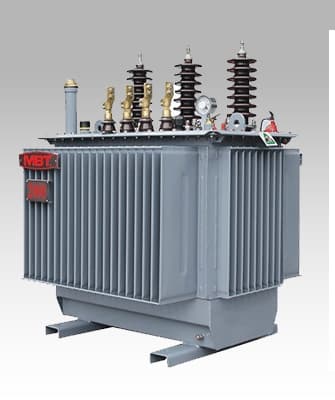
Distribution transformers step medium-voltage feeders down to utilisable low voltage for industrial plants, campuses, and utilities. Marketing copy stresses precision cores, premium conductors, advanced insulation, low losses, low noise, and long life under continuous duty. Standard value propositions include off-circuit taps (+5% / –10% in 2.5% steps) or on-load tap changers for wider regulation bands, Class-A insulated copper windings, Dyn11 vector groups, cable boxes or bus duct interfaces, and accessories such as Buchholz, PRV, oil/winding temperature indicators, and marshalling boxes.
Key Features
- 11 kV, 22 kV, and 33 kV primary classes (50 Hz)
- OCTC or OLTC tap arrangements per grid code
- Designed for five-year trouble-free performance statement on site
- Low loss / low noise core–coil packages
- Optional monitoring: oil/winding temperature, PRV, AR Buchholz contacts
Where it is used in real life
Everyday situations—not just industry names—so you can picture whether this product is relevant for you.
Residential layouts and townships
- The green pad-mounted transformer at the edge of a new housing layout that drops 11 kV from the street feeder to 415 V for streetlights, pumps, clubhouses, and villas.
- High-rise apartment clusters where each tower taps the same ring—distribution transformers split capacity so one feeder outage does not black out every block.
Shopping malls, IT parks, and hospitals
- The main indoor oil or dry transformer that feeds the building bus—often sized with spare capacity for future floors, anchor tenants, or extra chillers.
- Hospitals with N+1 chiller philosophy: duplicate transformers or split secondary buses so critical wards stay powered during transformer maintenance windows.
Factories on dedicated HT supply
- When the DISCOM hands you an 11 kV or 33 kV ring and you need your own step-down to plant 415 V before your internal APFC and motor control centre.
- Steel rolling or large stamping plants where incoming HT is stepped once at the fence and large motor groups are fed through dedicated LV sections.
Infrastructure, campuses, and renewables interfaces
- Metro depots, airport cargo zones, and logistics parks where medium voltage from the grid is stepped to utilisable LV for cranes, conveyors, and HVAC.
- Solar or co-generation plants exporting at medium voltage but needing local LV for inverters, controls, and station services—distribution class magnetics ties it together.